
How to prevent caustic soda crystallization in storage tanks
How to prevent caustic soda crystallization in storage tanks
Caustic Soda crystallization can block transfer lines, disrupt dosing and leave storage tanks difficult to operate. Preventing it starts with understanding how solution concentration affects crystallization temperature—not simply turning up the heat. Reliable storage depends on maintaining an appropriate temperature range, checking insulation and heat tracing, and monitoring cold spots around outlets and pipework.
A tank temperature reading alone is not enough. The bulk liquid may remain warm while an exposed valve or idle transfer line cools enough for crystals to form.
Set the temperature around the actual concentration
Aqueous sodium hydroxide does not have one universal freezing point. Its crystallization behavior changes with concentration and the formation of different solid hydrates. The relationship is not linear, so neither a generic temperature setting nor the assumption that “more dilute always means safer” is a sound operating basis.
Confirm the delivered concentration from batch documentation, then consult the supplier’s concentration–temperature diagram or product handling guidance. Establish an operating range above the relevant crystallization boundary, allowing for local heat loss, instrument uncertainty and temperature changes during shutdowns. The upper limit must also suit the tank, lining, seals and other wetted components.
Do not change concentration casually to solve a winter storage problem. Dilution releases substantial heat and changes dosing strength, available storage capacity and downstream process conditions. Any change needs an engineered procedure and process review.
Protect the coldest parts of the system
Inspect the complete liquid path, not just the tank shell. Bottom outlets, valve bodies, pump suction lines, instrument connections and stagnant branches can lose heat faster than the stored inventory. Wind exposure and damaged insulation make these locations particularly vulnerable.
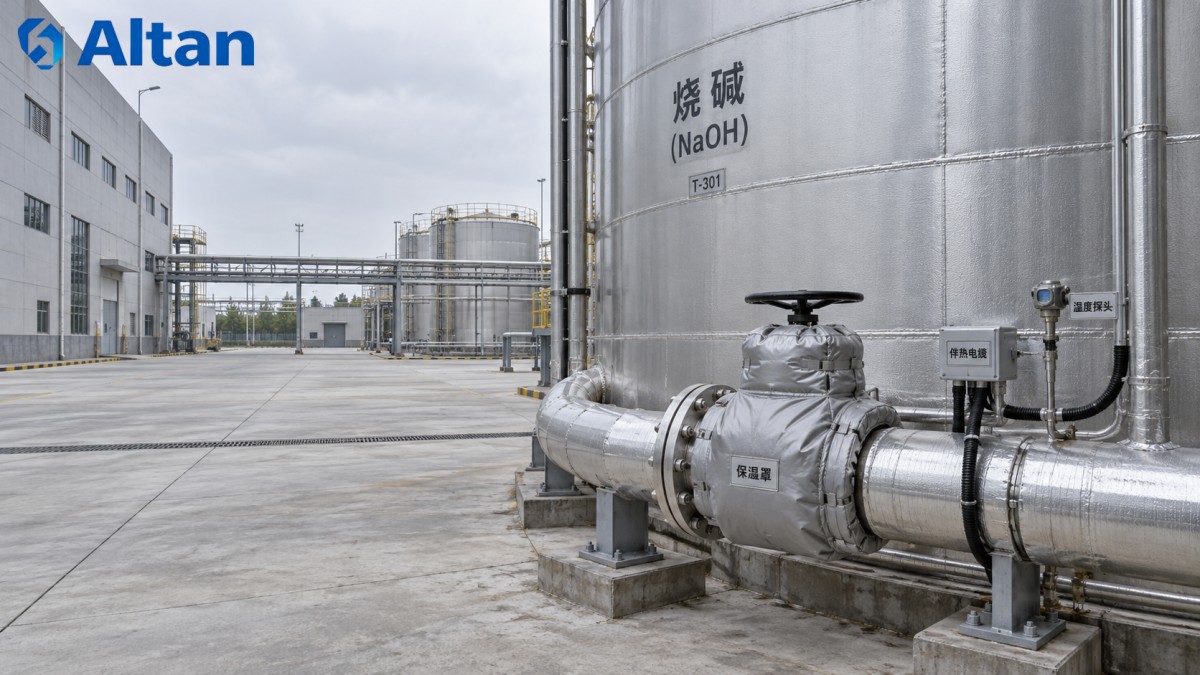
- Check insulation condition: repair missing sections and weatherproofing defects, especially around removable valve covers and pipe supports.
- Verify heat tracing performance: inspect power supplies, controllers, sensors and heating circuits. A controller showing “on” does not prove that every traced section is heating.
- Review intermittent-use lines: provide suitable thermal protection or a validated drain-back arrangement where the system design permits it.
- Check heating compatibility: avoid uncontrolled hot spots that can damage equipment or accelerate corrosion. Heating surfaces and controls must suit the solution and construction materials.
Recirculation can help reduce temperature differences when the system is designed for it, but it cannot compensate for inadequate heating. The recirculation loop itself also needs protection against cooling.
Monitor conditions before flow becomes restricted
Place temperature monitoring where it reveals operational risk, rather than relying only on a convenient tank location. Depending on the installation, this may include the lower tank area, outlet assembly and exposed pipework. Set low-temperature alarms early enough for operators to respond before crystallization begins.
Trend temperature alongside transfer flow, pump behavior and discharge pressure. Reduced flow can indicate crystallization, but it can also result from a blocked strainer, valve fault or pump problem. Diagnose the cause before increasing pump speed or pressure.
Before cold weather, test alarms and review the response to heating failure, power loss and extended shutdown. Include incoming deliveries: warm product entering the tank does not demonstrate that the unloading hose and receiving line are adequately protected.
If crystals appear, avoid improvised recovery
Stop the affected transfer and follow the site’s isolation and recovery procedure. Do not force a pump against a blockage, use an open flame, or add water directly to a blocked line or tank as a quick thawing method. Caustic dilution can generate intense heat and splashing.
Recovery should use controlled heating within equipment limits, with appropriate venting and protection against pressure in trapped sections. Before restarting, confirm that the flow path is clear and the solution is sufficiently uniform for accurate dosing. Appropriate chemical-resistant protective equipment and accessible emergency washing facilities remain essential.
For supply planning, agree on concentration, delivery conditions and handling documentation before shipment. Shandong Qilun Chemical supplies fertilizers, industrial chemicals and specialty chemical products worldwide, supporting buyers with product sourcing, consistent quality, responsive service and export coordination. For caustic soda storage, the useful next step is to align the supplied grade’s handling guidance with the site’s lowest expected temperature and verified heating capacity.
Related Posts
- ▶ How to select plastic resins by melt flow rate for injection molding
- ▶ Is potassium sulfate worth the premium over potassium chloride?
- ▶ How to prevent caustic soda crystallization in storage tanks
- ▶ Choosing an NPK Fertilizer Ratio Based on Soil Tests and Crop Needs
- ▶ How to Reduce Ammonia Loss When Applying Urea to the Soil Surface
- ▶ Potassium Sulfate in Fertigation: Solubility and Calcium Compatibility
Send Us A Message