
Potassium Sulfate in Fertigation: Solubility and Calcium Compatibility
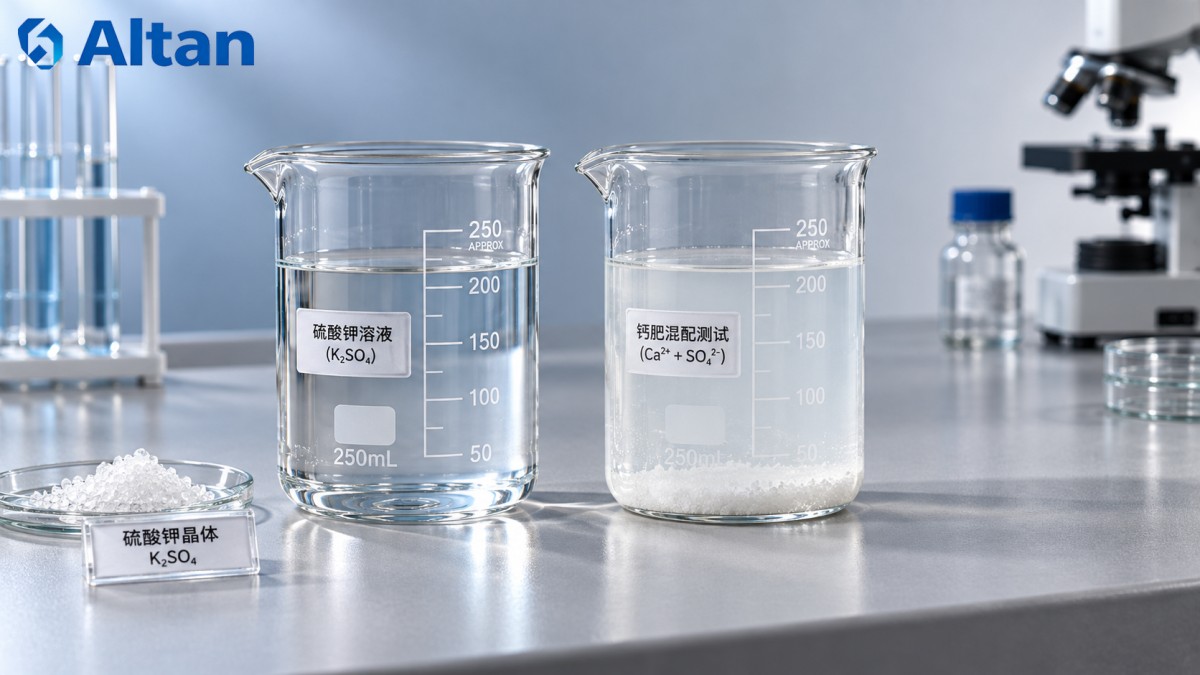
Potassium sulfate can supply chloride-free potassium and sulfur through fertigation, but reliable use depends on two separate conditions: the fertilizer must remain dissolved at the lowest operating temperature, and the resulting solution must not precipitate when it encounters calcium. A clear potassium sulfate stock solution does not, by itself, demonstrate compatibility with calcium nitrate or calcium-rich irrigation water.
The practical distinction is between concentrated stock solutions and diluted irrigation water. Potassium sulfate and calcium fertilizers should be kept in separate stock tanks. Their use in the same fertigation program can still be feasible after sufficient dilution, provided water chemistry, injection conditions, and compatibility testing support it.
Solubility limits apply to the actual solution, not just the product label
At approximately 20°C, pure potassium sulfate dissolves at roughly 11 g per 100 g of water. This is an equilibrium value for a simple potassium sulfate–water system, not a recommended stock concentration. It should not be interpreted as 110 g per liter of finished solution or used as a guaranteed limit for mixed-fertilizer stocks.
A workable concentration needs a margin below saturation. Lower water temperature reduces solubility, while other dissolved salts change the solution chemistry. Potassium-containing fertilizers can further restrict dissolution through the common-ion effect. A formulation that dissolves during warm preparation may therefore crystallize during cooler overnight storage.
Dissolution rate and equilibrium solubility also require separate evaluation. Fine particles and effective agitation can shorten preparation time, but neither raises the final equilibrium limit. Heating can help preparation, yet it does not establish storage stability after cooling.
The intended injection ratio determines whether the stock concentration is realistic. For example, delivering 100 mg/L of potassium with a 100-fold stock-to-final dilution requires approximately 10 g/L of potassium in the stock. For a product containing 50% K2O equivalent—about 41.5% elemental potassium—that corresponds to roughly 24 g/L of product. Increasing the concentration factor raises the required stock loading proportionally.
Calcium compatibility is controlled by precipitation chemistry
When dissolved calcium encounters sulfate, calcium sulfate can precipitate if the solution exceeds saturation. Under common irrigation conditions, gypsum is the relevant solid phase:
Ca2+ + SO42− + 2H2O ⇌ CaSO4·2H2O(s)
The driving force depends on calcium and sulfate activities, rather than fertilizer names alone. Concentration, ionic strength, temperature, and existing dissolved ions all affect the result. Consequently, there is no single universally safe mixing ratio for potassium sulfate and calcium nitrate.
Concentrated stocks create a particularly unfavorable situation because both ions can reach high local concentrations. Adding one fertilizer slowly to the other does not remove this incompatibility. Even if the mixture initially appears clear, crystal formation can be delayed.
Dilution lowers precipitation risk, but injection arrangement matters. Separate tanks offer limited protection if their concentrated discharge streams meet before adequate mixing with irrigation water. Injection points should provide sufficient dilution and mixing before the streams interact; where that cannot be demonstrated, separate dosing periods with an appropriate water flush offer a more conservative approach.
Source water can introduce calcium before any fertilizer is added
A potassium sulfate tank can develop calcium sulfate sediment even when calcium nitrate is stored elsewhere. Calcium already present in the water used to prepare the stock may be sufficient to create a problem at high sulfate concentrations.
Water analysis should distinguish calcium, magnesium, sulfate, bicarbonate or alkalinity, pH, and electrical conductivity. Total hardness alone does not identify the calcium concentration needed for a calcium sulfate assessment. Existing sulfate also contributes to the final sulfate load.
Alkalinity introduces a different precipitation pathway: calcium carbonate. Acid treatment may reduce carbonate-related deposits, but normal irrigation-water acidification should not be treated as a dependable remedy for calcium sulfate incompatibility. Likewise, conductivity indicates total ionic loading but cannot establish compatibility on its own.
Test stock stability and diluted compatibility separately
A useful test reproduces the proposed formulation and operating conditions, rather than combining arbitrary amounts in a beaker.
- Check stock preparation: Use the actual source water, intended fertilizer grade, stock concentration, mixing sequence, and lowest expected preparation temperature. Record dissolution time and residual solids.
- Check storage stability: Hold the solution through the expected storage period and cooling conditions. Inspect for haze, crystals, and settled material, including deposits that appear only after standing.
- Check final-water compatibility: Prepare the intended diluted nutrient solution using the same water and fertilizer proportions. Observe it immediately and after a period representative of system residence or storage.
- Check injection conditions: A clear final mixture does not validate a system where concentrated streams contact each other. Confirm mixing performance or conduct a controlled injection trial.
A passing visual test is useful screening evidence, not proof that precipitation cannot occur. Where calcium and sulfate loading is substantial, saturation calculations using the full water analysis can strengthen the assessment. Filters may capture some solids, but filtration does not prevent precipitation downstream or restore nutrients already removed from solution.
Grade qualification should therefore include measured water-insoluble matter and dissolution behavior under the intended conditions, not only nutrient assay or a “water-soluble” description. Insoluble impurities, undissolved fertilizer, and newly formed precipitates require different corrective actions. Increasing agitation may address slow dissolution; it will not correct an incompatible calcium–sulfate formulation.
Related Posts
- ▶ How to select plastic resins by melt flow rate for injection molding
- ▶ Is potassium sulfate worth the premium over potassium chloride?
- ▶ How to prevent caustic soda crystallization in storage tanks
- ▶ Choosing an NPK Fertilizer Ratio Based on Soil Tests and Crop Needs
- ▶ How to Reduce Ammonia Loss When Applying Urea to the Soil Surface
- ▶ Potassium Sulfate in Fertigation: Solubility and Calcium Compatibility
Send Us A Message